
Julie Leggett Art Workshops September 10th Crazy Patchwork A5 Victorian Inspired Booking Now

A small piece of fabric can hold a surprising amount of colour, texture, memory, and experiment. That is one of the reasons crazy patchwork is such a rewarding workshop theme. It gives plenty of room to play, but it also asks for close looking, careful stitching, and thoughtful choices.
The next Julie Leggett Art workshop takes place on 10 September, from 10 am to 12 pm, and the focus will be crazy patchwork inspired by Victorian techniques. During the session, participants will create an A5 textile piece, building up irregular fabric shapes and exploring decorative stitches to bring the surface to life.
This is a lovely theme for anyone who enjoys textiles, hand stitching, colour, mixed materials, or the slower pleasure of making something by hand. It is also a good follow-on from the August workshop, which was energetic, absorbing, and full of beautiful small-scale results.

The September workshop will explore Victorian inspired crazy patchwork
Crazy patchwork has a rich history, and its Victorian connections make it especially interesting for a textile workshop. Unlike regular patchwork, which often uses repeated blocks and measured patterns, crazy patchwork is built from irregular shapes. Pieces of fabric are joined in unexpected ways, then decorated with hand stitches, trims, and embellishments.
In Victorian examples, makers often used luxurious fabrics such as silk, velvet, satin, and brocade. They created surfaces that felt personal and expressive, with seams becoming places for decoration rather than just construction. A join between two fabrics might be covered with feather stitch, herringbone stitch, chain stitch, or another decorative line. The stitching did not merely hold the work together. It added rhythm, emphasis, and character.
For the September session, the Victorian influence offers a starting point rather than a strict rulebook. The aim is not to copy an antique piece exactly. The aim is to take inspiration from the spirit of the technique: layered, inventive, detailed, and full of individual choice.
That makes it an ideal workshop subject. Crazy patchwork allows for freedom, but it still gives enough structure to guide the making process. Each participant can make different decisions about colour, contrast, thread, and stitch while working towards the same finished format.
The result will be a small but complete A5 piece, large enough to explore composition and stitch, yet manageable within the two-hour workshop. Instruction is provided for you to take away if you need to complete your piece at home.
Why an A5 piece is the right size for this session
A5 is a wonderfully practical size for textile exploration. It gives space for a satisfying arrangement of patches without becoming too large to complete or develop during the workshop.
In a two-hour session, scale matters. A large piece can become overwhelming, especially when decorative stitching is part of the process. A very small sample can feel too limited. A5 sits neatly between the two. It allows for:
A clear composition with several fabric areas
A chance to try more than one decorative stitch
Enough surface detail to make the piece feel finished
A format that is easy to handle, store, mount, or continue at home
It also encourages good decision-making. With a smaller surface, every stitch and fabric choice has an impact. A bold colour becomes a focal point. A row of stitches can frame a shape or soften an edge. A change of thread weight can shift the mood of the whole piece.
The workshop will give participants time to think about how the patches sit together before building up the surface with stitch. That process is often where the pleasure lies. The work changes under the hand. A plain seam becomes decorative. A fabric scrap starts to feel considered. Small details begin to connect.
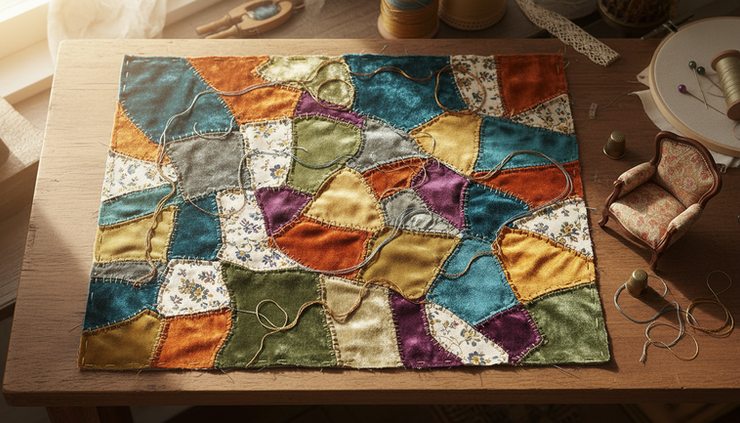
Decorative stitches will bring the patchwork to life
One of the most enjoyable parts of crazy patchwork is the stitching. Decorative stitches can be simple or detailed, neat or expressive, subtle or bold. They can outline shapes, hide joins, create movement, add contrast, or simply celebrate the act of hand sewing.
The September workshop will include time to explore decorative stitches as part of the A5 piece. This might include familiar stitches used in new ways, or stitches that participants have not tried before. The point is to build confidence and see what each stitch can do on fabric.
Decorative stitching works beautifully in crazy patchwork because it turns seams into design features. In standard sewing, seams are often tucked away or made as invisible as possible. In crazy patchwork, they are invited to stand out.
A line of stitching can:
Join two colours with a neat edge
Add texture to a plain fabric
Create contrast against patterned material
Lead the eye around the composition
Give a handmade quality that cannot be rushed
This is where Victorian inspiration becomes especially useful. Historic crazy patchwork often celebrates excess and detail, but it also shows how small repeated marks can create unity. A piece made from varied fabrics can become coherent when stitch lines connect the different areas.
For anyone newer to decorative hand stitching, the session offers a supportive way to practise. For more experienced makers, it offers room to play with colour, stitch placement, and surface design.
The workshop is not about perfection. It is about looking, responding, and building up a piece step by step.
What participants can expect on 10 September
The upcoming workshop will run from 10 am to 12 pm on 10 September. Across the two hours, the session will focus on making, experimenting, and enjoying the tactile nature of stitched textiles.
The general rhythm of the morning will be simple and practical. Participants will begin by looking at the crazy patchwork theme and considering how Victorian techniques can influence a contemporary A5 textile piece. From there, the focus will move into arrangement, joining, and decorative stitch.
Expect a session that is creative, concentrated, and hands-on. The time is short enough to keep the pace lively, but long enough to settle into the work and see the piece develop.
The A5 format means participants can leave with a textile work that feels complete in its own right, or with a strong starting point to continue developing later. Some may choose to keep the work as a sample. Others may see it as a panel for a larger project, a framed textile piece, a journal cover idea, or a reference for future stitching.
The workshop will suit people who enjoy:
Textiles and mixed media
Hand stitching
Colour and pattern
Slow making
Historical art and craft techniques
Small creative projects with a clear outcome
No two pieces will look the same. That is one of the joys of the theme. Crazy patchwork responds to individual taste. One person might lean into rich colour and dense stitch. Another might choose soft tones, open spacing, and delicate marks. Both approaches can work beautifully.

Looking back at the August workshop
The August workshop had a different focus, but it carried the same spirit of concentrated creative making. Participants worked on a small abstract beach scene, using a compact format to explore colour, shape, and atmosphere.
The subject gave everyone a clear visual idea to respond to, while still leaving plenty of room for personal interpretation. Some beach scenes can be calm and minimal, with simple bands of sea, sand, and sky. Others can be more textured and energetic, suggesting wind, tide, pebbles, or shifting weather.
The session was both enjoyable and intensive. That combination is often where the best workshop energy appears. An intensive workshop does not mean stressful. It means focused. There is a sense of momentum when everyone is making decisions, trying techniques, and watching their pieces take shape.
The August beach scene workshop asked participants to work closely within a small scale. That can be surprisingly freeing. With less space to fill, makers often become bolder. Colour choices become clearer. Shapes become more direct. Textures do more work.
The results from the session showed how much can happen in a short workshop when the project is well framed. A small abstract scene can hold atmosphere without needing exact detail. It can suggest a place, a feeling, or a memory through carefully chosen materials and marks.
That same sense of focus will carry into September, although the subject will shift from abstract landscape to stitched textile surface. The beach scene workshop was about building atmosphere in a small composition. The crazy patchwork session will be about building pattern, surface, and detail through fabric and stitch.
Both share a useful creative lesson: a small format can still offer a rich making experience.
Why crazy patchwork is such a good next step
After the August workshop’s abstract beach scene, crazy patchwork feels like a natural next step. It keeps the small-format intensity, but changes the creative language.
Instead of suggesting sea and shore, the September session will focus on fragments, joins, stitches, and surface texture. The work becomes less about representing a scene and more about composing with fabric itself.
That shift can be refreshing. It encourages a different kind of attention. Participants will look at how colours meet, how patterns sit beside each other, and how stitches can change the relationship between two fabrics. A seam is no longer just a line where pieces meet. It becomes a place to add detail.
Crazy patchwork also gives participants permission to use contrast. Smooth can sit beside rough. Plain can sit beside patterned. Dark can sit beside pale. A neat stitch can run across an irregular shape. The interest comes from the conversation between materials.
The Victorian influence adds another layer. It invites decorative richness, but it also reminds us that textile work has always been a place for personal expression. Historical techniques can feel surprisingly fresh when handled with contemporary colours and a relaxed approach.
This is why the September workshop should appeal to both returning participants and anyone joining a Julie Leggett Art session for the first time. The theme is accessible, but not simplistic. It offers guidance without closing down choice.
Booking is now open for the September workshop
Places are available for the 10 September crazy patchwork workshop, running from 10 am to 12 pm. If the August session is anything to go by, it will be a busy, absorbing morning with plenty of making packed into the two hours.
To book, visit the Events and Workshop page on the Julie Leggett Art website. This is the best place to find the latest workshop details and reserve a spot.
Because the session focuses on an A5 piece, it offers a complete and satisfying project without needing a full day. It is a chance to step into textile making, try decorative stitches, and take inspiration from Victorian crazy patchwork in a friendly, creative setting.
A creative morning to look forward to
The September workshop brings together several lovely things: historical inspiration, tactile materials, decorative hand stitching, and the satisfaction of completing a small textile piece. Crazy patchwork is expressive, forgiving, and full of detail, which makes it a strong theme for a focused two-hour session.
The August abstract beach scene workshop showed how enjoyable and intensive a small creative format can be. September will build on that energy with a new subject and a fresh set of possibilities.
If a morning of fabric, stitch, colour, and Victorian inspired detail sounds appealing, book a place through the Events and Workshop page on the Julie Leggett Art website. The workshop takes place on 10 September, 10 am to 12 pm, and participants will leave with an A5 crazy patchwork piece shaped by their own choices and stitches.


Comments